
Introduction
When it comes to building long-term wealth, two strategies stand out in the mutual fund universe. Specifically, you can invest a Lump Sum all at once, or commit to a Systematic Investment Plan (SIP). Both approaches have their merits and their pitfalls. Therefore, understanding how they work and choosing the one that aligns with your goals and temperament is the first step toward financial success.
Why Consider Mutual Funds?
- 📊 Diversification: Reduce risk by spreading your investment across sectors and companies.
- 👨💼 Professional Management: Experts handle the research and decision-making.
- 💸 Affordable Entry: Start with as little as ₹500 through SIPs.
- 🔁 Flexibility: Choose from equity, debt, hybrid, or sector-specific funds.
What Is a Lump Sum Investment?
A lump sum investment means deploying your entire earmarked capital into the market in a single transaction. As a result, you get full market exposure at once. It offers immediate and full exposure to market movements and is generally favored when the investor anticipates a market uptrend or wants to seize a perceived opportunity.
A lump sum investment involves deploying your entire available capital at once.
How Does Lump Sum Work?
In a lump sum investment, the entire amount is invested at the current Net Asset Value (NAV) of a mutual fund. This means your full capital starts compounding immediately. Consequently, this approach is ideal when markets are low or expected to rise steadily.
Key Benefits:
- Maximum exposure to market growth from Day 1.
- Best suited when markets are low or recovering.
- Ideal for experienced investors with strong conviction.
💰 Lump Sum Investment
✅ Invest your entire amount at once
📈 Great when markets are rising
⚠️ Risky if markets dip right after
👉 Suits experienced investors or post-correction opportunities.
What Is a Systematic Investment Plan (SIP)?
A Systematic Investment Plan (SIP) is a disciplined investment strategy that allows individuals to invest a fixed amount in a mutual fund scheme at regular intervals—typically monthly or quarterly. Instead of investing a lump sum all at once, SIPs enable investors to accumulate wealth gradually over time. In addition, it promotes disciplined investing.
How Does SIP Work?
In a SIP, a predetermined amount is auto-debited from your bank account and invested into a chosen mutual fund scheme. This helps investors purchase more units when prices are low and fewer units when prices are high—a concept known as rupee-cost averaging.
Key Benefits of SIPs:
- Rupee-Cost Averaging: Reduces the impact of market volatility by averaging out the cost per unit.
- Power of Compounding: Investing consistently over time helps generate wealth through compounding.
- Convenient & Automated: Makes investing hassle-free through auto-debits and systematic execution.
- Encourages Financial Discipline: Promotes regular savings and long-term planning.
📅 SIP – Systematic Investment Plan
✅ Invest smaller amounts regularly
🔁 Benefits from market volatility (rupee cost averaging)
🛡️ Lower risk from timing the market
👉 Ideal for new investors or long-term planners.
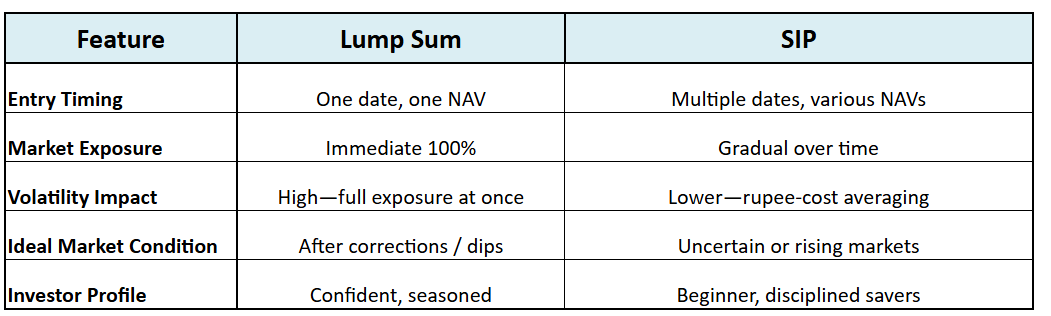
Side‑by‑Side Comparison